

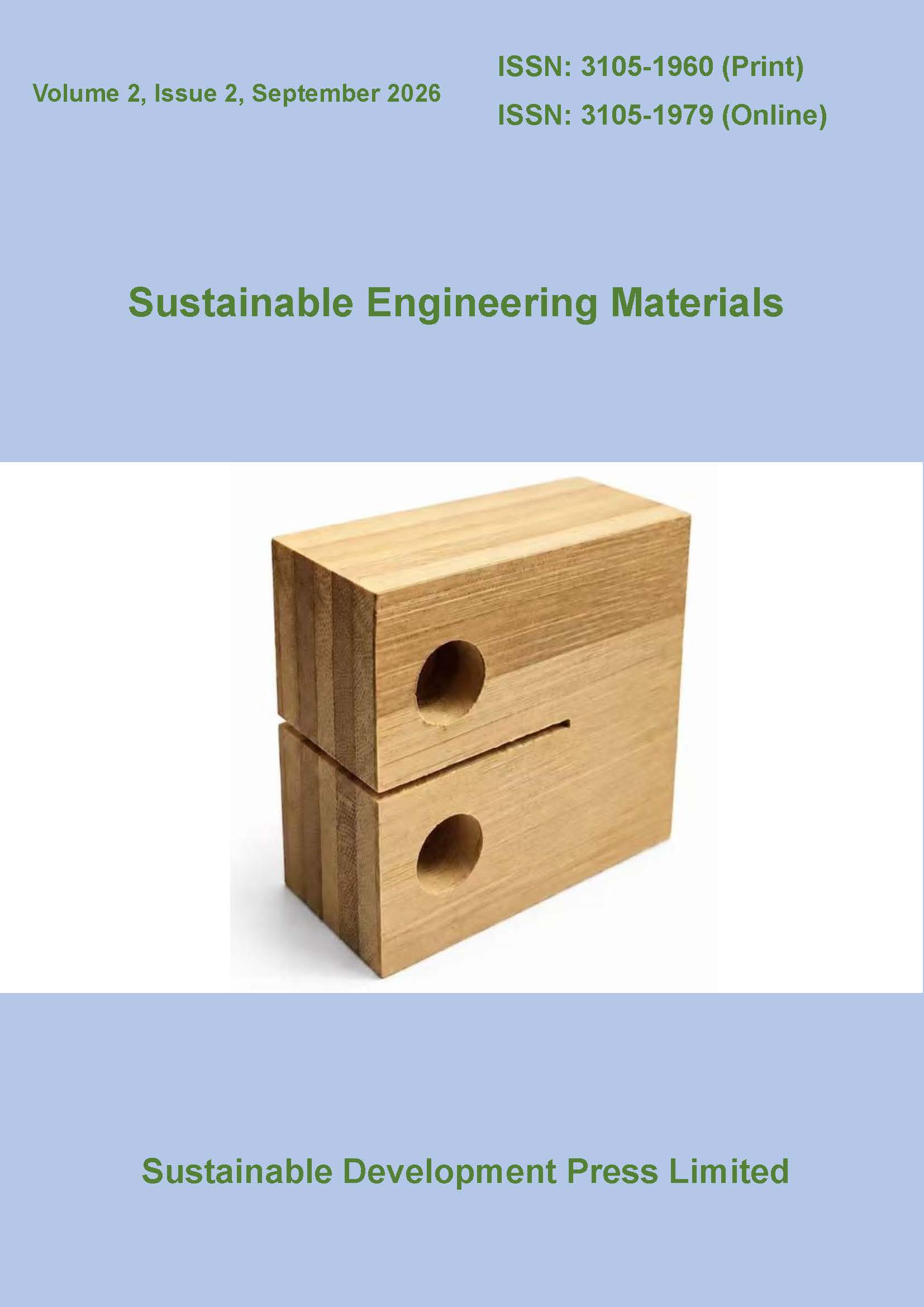
- ISSN: 3105-1960 (print) Impact Factor:Request pending
- ISSN: 3105-1979 (online) Publication Frequency:Three issues per year
About the Journal
Sustainable Engineering Materials (SUEM; Sustain. Eng. Mat.) is an interdisciplinary journal publishing original research covering all aspects of science and technology concerned with Sustainable Engineering Materials.With the development of the journal, the publication frequency of Sustainable Structures was two issues per year for 2025, three times a year from 2026. The scope of the journal is devoted to reports of new and original experimental and theoretical research as well as the sustainable applications in the areas of engineering materials. Journal publications include mainly as following: Reviews, Research Papers, Technical notes, Meeting Reports, and Case Reports. With publication fees supported by Sustainable Development Press Limited (SDPL), SUEM is an open access but free international journal focusing on the study of sustainable engineering materials. PDF versions of all papers published in the journal could be downloaded freely from the journal website!
- OPEN ACCESS ARTICLE
- Experimental investigation on Mode -Ⅰ interlaminar fracture behavior of laminated flattened-bamboo composite measured by VIC-3D technique
- Sustainable Engineering Materials Vol.2,No.2,2026 DOI:10.54113/j.suem.2026.000024 Online published:2026-9-5
- Abstract Mode - I fracture tests loaded parallel to grain were performed on 10 groups of laminated flattened-bamboo composite (LFBC) specimens using compact tension (CT) method, and crack extension was monitored by VIC-3D (video image correlate, 3D) technique. Nine of the groups were interlaminar (RL) fracture considering specimen thickness (B) and initial crack length to width ratio (a/W), and one group was standard specimens for intralaminar (TL) fracture as a control. It was shown that the failure mechanism of RL fracture was fiber fracture and ground tissue damage, while TL fracture was adhesive failure accompanied by a small amount of fiber fracture. The difference in the failure mechanism determined the uncertainty of crack extension in RL, while the crack extension in TL was continuous. On this basis, different forms of load-displacement curves and load-crack curves were analyzed. In addition, a/W had no effect on the fracture toughness of RL, while the condition value of fracture toughness gradually increased and reached stability with increasing thickness B. The RL fracture toughness of LFBC obtained from the test was 20.8 MPa·mm1/2. The tensile strain field during crack extension was always concentrated at the crack tip, while the compressive strain appeared at the bottom of the specimen. An empirical equation for predicting the critical load of RL fracture was proposed by fitting to the test data.… More
-
 Views:72
 Downloads:95
 Download
- OPEN ACCESS ARTICLE
- Effect of high rice husk ash replacement on the mechanical performance of Limestone-Modified CEM II/A-LL 32.5R concrete
- Sustainable Engineering Materials Vol.2,No.2,2026 DOI:10.54113/ji.suem.2026.000023 Online published:2026-9-5
- Abstract This study investigates the influence of rice husk ash (RHA) characteristics and replacement level on the fresh and hardened performance of mortars incorporating Portland limestone cement (CEM II/A-LL 32.5R). Four RHA types (RHA-A, RHA-B, RHA-C, and RHA-D) with different physicochemical characteristics were incorporated at replacement levels of 5–60% at a constant water-to-binder ratio of 0.50. The effects of silica structure and content, loss on ignition, and particle fineness on mortar flowability, compressive strength, and tensile strength were evaluated at 7, 28, and 91 days. The results demonstrate that RHA performance is strongly dependent on its physicochemical characteristics and replacement level. RHA-A and RHA-B exhibited a progressive reduction in mechanical performance at high replacement levels, whereas RHA-C and RHA-D maintained or enhanced strength over a substantially wider replacement range. Notably, RHA-C and RHA-D achieved substantial strength enhancement at replacement levels of up to 40%, with RHA-D exhibiting the highest later-age performance. Based on the combined assessment of compressive strength and microhardness, the optimum replacement levels were identified as 30% for RHA-A, 20% for RHA-B, 50% for RHA-C, and 60% for RHA-D. At these levels, the 28-day compressive strength was comparable to the reference cement mortar for RHA-A and increased by 2.18%, 10.45%, and 7.43% for RHA-B, RHA-C, and RHA-D, respectively. The findings demonstrate that the suitability of RHA as a high-volume supplementary cementitious material is governed not only by its replacement level but also by its physicochemical characteristics, highlighting the importance of RHA-specific characterization when designing sustainable cementitious systems.… More
-
Views:61
Downloads:60
Download
- OPEN ACCESS ARTICLE
- Effect of material imperfections on thermal behavior in metal matrix composites: a finite element approach
- Sustainable Engineering Materials Vol.2,No.2,2026 DOI:10.54113/j.suem.2026.000022 Online published:2026-9-5
- Abstract This study examines the thermal stress behavior of metal matrix composites (MMCs), with a focus on the influence of voids on thermal strain and the coefficient of thermal expansion (CTE). A finite element model (FEM) was developed using the software ABAQUS to simulate the thermal behavior of MMCs with ceramic particle reinforcement and to compare the models with and without voids using a two-dimensional periodic unit cell approach. The results showed that voids significantly increased thermal strain. At 473 K, the presence of voids increased the thermal strain by 8.50% in Model 1 and 2.27% in Model 2 compared with their corresponding void-free configurations. Additionally, the composite with voids exhibited a higher CTE, confirming that microstructural flaws impact thermal behavior. The thermal stress response of the composite with voids was about 15% higher than that of the control samples, underlining how voids affect the composite's thermal behavior. These results show the need to model material imperfections, including voids, accurately when determining the thermal performance of composites. The findings provide valuable insights for optimizing the design and reliability of MMCs, particularly in applications where thermal behavior is critical, such as in aerospace, automotive, and energy industries.… More
-
Views:145
Downloads:88
Download
- OPEN ACCESS ARTICLE
- Innovative sustainable concrete using waste tyre steel fibres and milled palm kernel shell
- Sustainable Engineering Materials Vol.2,No.2,2026 DOI:10.54113/j.suem.2026.000021 Online published:2026-9-5
- Abstract Over the years, numerous studies have been carried out on the sustainable use of waste tyre steel fibre and palm kernel shell in concrete production. However, the study on the integration of waste tyre steel fibre (WTSF) and milled palm kernel shell (MPKS) in concrete production, especially fibre reinforced concrete (FRC) is yet to be evaluated hence, this research studied the effects of waste tyre steel fibre and milled palm kernel shell as fine aggregate partial replacement in FRC. Five different sets of concrete samples were cast which are, ordinary concrete (A0), concrete with 10% MPKS replacement with fine aggregate (A1), and others with 10% MPKS and 0.5% WTSF at a varying length of 25 mm, 35 mm and 45 mm (A2, A3 and A4) respectively, the diameter of the WTSF ranges from 1.34 mm-1.69 mm. concrete mix of 1:1.5:3 and 0.6 water cement ratio were adopted. From the study, slump value decreased with an increase in the length of the WTSF. Furthermore, the compressive and splitting tensile strengths increased with increase in the length of fibres. The least and highest 28-day compressive strength values of 21.3 and 30 N/mm2 and tensile strength values of 1.9 and 3.2 N/mm2 were recorded for A0 and A4 respectively. Lastly, A4 showed the highest strength for both compressive and tensile strengths. This research shows an integration of MPKS and WTSF to improve mechanical properties of concrete structures thereby contributing to sustainable construction practices and waste management techniques.… More
-
Views:97
Downloads:82
Download
- OPEN ACCESS ARTICLE
- Mapping bio-asphalt technologies and deep investigation: a systematic bibliometric analysis
- Sustainable Engineering Materials Vol.2,No.2,2026 DOI:10.54113/j.suem.2026.000020 Online published:2026-9-5
- Abstract Bio-asphalt has emerged as a strategic solution for reducing the environmental footprint of pavement infrastructure by partially replacing petroleum-based binders with renewable biomass-derived resources such as bio-oil, lignin and agricultural by-products. Despite the rapid growth of experimental studies, a consolidated understanding of the intellectual evolution, performance-oriented research directions, and implementation challenges of bio-asphalt remains limited. This study presents a systematic bibliometric and performance-integrated review of 343 Scopus-indexed publications published between 1995 and 2025 to map the global development of bio-asphalt technologies. The results reveal an exponential increase in research output after 2015, driven by sustainability mandates, circular-economy initiatives, and advances in biomass conversion technologies. Science mapping indicates a clear thematic transition from early material substitution toward performance-oriented research focusing on rheology, durability, aging resistance, and hybrid modification strategies. A persistent performance imbalance between high-temperature rutting resistance and fatigue or low-temperature cracking resistance is identified as a central design challenge. Bio-oils are primarily used to enhance workability, rejuvenation efficiency, and cracking resistance, whereas lignin, polymers, and nanomaterials are increasingly incorporated to restore stiffness and mitigate rutting susceptibility. By integrating bibliometric analysis with engineering performance synthesis, this study identifies key research gaps and proposes a framework for the development of balanced, durable, and low-carbon bio-asphalt systems.… More
-
Views:69
Downloads:84
Download
- OPEN ACCESS ARTICLE
- Dowel-bearing properties of bolted joints in eucalyptus-based wood scrimber composites: An experimental and numerical investigation
- Sustainable Engineering Materials Vol.2,No.1,2026 DOI:10.54113/j.suem.2026.000019 Online published:2026-6-9
- Abstract Understanding the dowel-bearing behavior of engineered wood products is essential for the design of reliable mechanical connections in sustainable timber structures. This study investigates the embedment performance of eucalyptus-based wood scrimber (EBWS), a high-density and low-carbon engineered composite, under various dowel diameters and loading directions. A total of 240 specimens were tested using both half-hole and full-hole embedment methods across four orthotropic configurations. The influence of dowel diameter, loading orientation, and test configuration on bearing strength and initial stiffness was analyzed. Finite element simulations incorporating the Hill yield criterion and localized “weak zones” were conducted using ABAQUS to capture stress evolution and failure mechanisms. Results show that dowel diameter significantly affects stiffness and strength evolution, and that half-hole tests yield higher and more stable embedment performance than full-hole tests. The findings provide experimental insight and modeling strategies for the reliable application of EBWS in dowel-connected structural systems.… More
-
Views:224
Downloads:307
Download
- OPEN ACCESS ARTICLE
- Enhancing eco-concrete: the role of natural fibres and water content to improve the strength and lifespan of sustainable pavement materials
- Sustainable Engineering Materials Vol.2,No.1,2026 DOI:10.54113/j.suem.2026.000018 Online published:2026-6-9
- Abstract Many concerns have been raised about the adverse environmental impacts of conventional concrete. Using natural sponge fibre (NSF) in concrete to improve mechanical and durability properties makes it a sustainable innovation in construction materials. Hence, this study aims to explore the combine effects of NSF content (0.00%, 0.25%, 0.50%, 0.75%) and water-to-binder (wb) ratios (0.45, 0.50, 0.55) on the performance of natural sponge fibre reinforced concrete (NSFRC) for pavement applications. Experimentally, concrete mixtures were prepared by adding NSF and wb ratios. The impact of fibre content (Fc) and wb on the physical and mechanical properties of NSFRC was evaluated and compared with those of plain concrete (Pc). The results indicate that advancing NSF content decreases flowability, density, and compressive strength compared to the Pc. However, tensile splitting strength increases significantly enhances at 0.75% fibre and wb 0.50, improving crack resistance and toughness, as shown by the stress-strain curves and evidenced by the scanning electron microscopy (SEM) microstructure. Research indicates NSFRC serves as a sustainable pavement material suitable for engineering applications, warranting further research into its long-term field performance and standardization.… More
-
Views:197
Downloads:272
Download
- OPEN ACCESS ARTICLE
- Predicting compressive strength of fly ash blended sandcrete using machine learning models
- Sustainable Engineering Materials Vol.2,No.1,2026 DOI:10.54113/j.suem.2026.000017 Online published:2026-6-9
- Abstract Cement-based materials, particularly sandcrete, play a crucial role in the construction industry, where demand for sustainable and high-performance materials is increasing. Fly ash, a byproduct of coal combustion, has gained attention as a supplementary cementitious material (SCM) to improve the sustainability of these materials. However, predicting the compressive strength of fly ash-blended mortars, which is essential for ensuring the structural integrity and durability of construction materials, remains a challenge. This study aims to address this gap by leveraging advanced machine learning techniques to predict the compressive strength of fly ash blended sandcrete, using key input variables such as aggregate-to-binder ratio (Agg/B), fly ash-to-binder ratio (FA/B), water-to-binder ratio (W/B), and curing time. While previous research has focused on conventional cement mortars, few studies have integrated these key variables using machine learning models. The goal of this research is to develop a reliable and accurate predictive model for compressive strength, filling a gap in existing literature regarding the influence of multiple input variables on mortar performance. The study employs four machine learning models - Artificial Neural Networks (ANN), K-Nearest Neighbors (KNN), Support Vector Regression (SVR), and Extreme Gradient Boosting (XGB) - to evaluate their performance in predicting compressive strength. The results show that XGB outperforms other models, achieving an R² of 0.84 for training data and 0.74 for testing data, along with the lowest prediction errors. These findings demonstrate the potential of machine learning models, particularly XGB, in optimizing mix designs and improving sustainability in construction, offering valuable insights for future material innovations.… More
-
Views:194
Downloads:271
Download
- OPEN ACCESS ARTICLE
- Unveiling the impact of steel fiber type on self-compacting concrete performance under intense fire
- Sustainable Engineering Materials Vol.2,No.1,2026 DOI:10.54113/j.suem.2026.000016 Online published:2026-6-9
- Abstract One of the problems that concrete structures may face is fire exposure, which can cause several issues for concrete structures, deterioration, reduction in serviceability, and potentially demolition. In this study, self-compacting concrete was used and reinforced with steel fiber as a volume fraction Vf by 0.75, 1.25, and 1.75% for both hook and micro steel fiber. The fresh and mechanical properties of all the tested mixes were examined. It was observed that the addition of fibers reduced the fresh properties and increased the mechanical properties for both types of fibers, especially for hook steel fiber. To study the effect of fire exposure on the properties of concrete, the samples were subjected to direct burning at temperatures reaching 300, 400, and 500°C for one hour of exposure, followed by gradual cooling to ambient temperature. It was noted that the mechanical properties significantly decreased with increasing burning temperatures, and the presence of fibers mitigated the deterioration that concrete is subjected to during burning. This enhancement was directly proportional to the augmentation of fiber volume fraction for both types, except for 1.75% hook steel fiber at 400 and 500°C, where there was a decrease in the improvement rates. Moreover, as for 1.75% micro steel fibers, this behavior was observed at 500°C only.… More
-
Views:193
Downloads:262
Download
- OPEN ACCESS ARTICLE
- Recycling carbon-glass fiber composites via thermal process: mechanical property evaluation
- Sustainable Engineering Materials Vol.2,No.1,2026 DOI:10.54113/j.suem.2026.000015 Online published:2026-6-9
- Abstract Polymer composites are not readily biodegradable in nature, resulting in significant material waste. The growing use of polymer composites has led to increased material waste due to their limited recyclability. This research recycles a carbon-glass fiber-reinforced hybrid composite (CGFRC) and investigates the mechanical properties of the recycled specimen, comparing them with those of the new specimen. The work focuses on recovering carbon and glass fiber from the epoxy matrix through a thermal recycling method and remanufacturing the composite with recycled fibers. New and recycled composite specimens underwent tensile and flexural strength tests to assess their mechanical properties. The findings showed that the recycled specimens had reduced physical and mechanical properties compared to the new ones. The new specimen demonstrates a tensile strength of 36.85 MPa and a flexural strength of 37.19 MPa. In contrast, the recycled specimens exhibit a tensile strength of only 11.15 MPa and a flexural strength of 29.82 MPa. This indicates a notable reduction in mechanical properties for the recycled material, which retains approximately 80% of its initial flexural strength but only 30% of its tensile strength. SEM analysis revealed the presence of voids, poor distribution of fibers, and epoxy residue in the recycled specimen.… More
-
Views:529
Downloads:547
Download
- OPEN ACCESS REVIEW
- Mechanical and durability properties of ultra-high-performance concrete of spent nuclear fuel dry storage systems: a review
- Sustainable Engineering Materials Vol.2,No.1,2026 DOI:10.54113/j.suem.2026.000014 Online published:2026-6-9
- Abstract Dry storage systems are used for interim storage of spent nuclear fuel (SNF). However, with the growing need to extend the operational periods of these systems, there are concerns about the degradation of their concrete overpacks, which could compromise the system's structural integrity and safety during hazardous events. Traditional concrete mixtures used in SNF dry storage systems have remained largely unchanged since their inception and often use conventional ingredients. These materials are susceptible to degradation mechanisms such as chemical attacks, alkali-silica reactions (ASR), and freeze–thaw cycles, which can lead to a loss of strength and durability over time. To address these challenges, this paper reviews the application of ultra-high-performance concrete (UHPC) as a promising alternative for spent nuclear fuel dry storage system overpacks. UHPC offers superior mechanical properties, exceptional durability, and reduced susceptibility to degradation mechanisms compared to conventional concrete. This paper focuses on the role of supplementary cementitious materials (SCMs) such as silica fume, fly ash, and metakaolin in enhancing UHPC performance for SNF storage applications. These SCMs have been shown to significantly improve the material’s microstructure, strength, and resistance to environmental stressors typically encountered in SNF storage environments. Moreover, incorporating SCMs supports sustainable construction by reducing cement consumption and associated carbon emissions. The review brings together existing research and experimental data, providing insights for engineers and researchers on developing UHPC mixtures that meet the rigorous demands of spent nuclear fuel dry storage systems, extending their service life and minimizing inspection intervals.… More
-
Views:212
Downloads:298
Download
- OPEN ACCESS ARTICLE
- The investigation of using waste plastic fiber in economic concrete production
- Sustainable Engineering Materials Vol.2,No.1,2026 DOI:10.54113/j.suem.2026.000013 Online published:2026-6-9
- Abstract Much research has been done on concrete using new materials, especially when reinforced with fibers, but researchers did not know how to include the plastic fibers in concrete. However, this study has investigated the effect of replacing natural aggregate with recycled coarse aggregate (RCA) at 25%, 50% or 75%, and adding plastic fiber (PF) at 0.5%, 1%, or 2% in concrete. Compressive strength, flexural strength, tensile strength, and elastic modulus were tested to gain knowledge of concrete behavior, and the study comprehensively covers hardened properties of concrete. The most important results were reached from the analysis of concrete properties, such as substituting a low amount of RCA by 25% and adding a small proportion of fiber by 1% can enhance the strength of a concrete; on the other hand, substituting larger amounts of RCA by higher than 50% and adding greater proportions of fiber up 2% can decrease of strength. The highest increase in compressive strength was recorded when a mixture of 25% of RCA with 1%PF by 10.92% compared to the control mixture.… More
-
Views:191
Downloads:323
Download
- OPEN ACCESS ARTICLE
- Size effect on the compressive properties of wood-plastic composite
- Sustainable Engineering Materials Vol.1,No.2,2025 DOI:10.54113/j.suem.2025.000010 Online published:2025-12-17
- Abstract Wood-plastic composite (WPC) is a kind of composite material made from a mixture of natural plant materials such as wood fibers or wood powder and special additives. The compressive strength is one of the main mechanical properties of WPC, which can be influenced by many factors. In this paper, the size effect is investigated by testing WPC specimens with proportional size and the same cross-section and different heights. The effect of specimen size on load bearing capacity, deformation capacity and strain distribution was analyzed. Based on the test data, three groups of stress-strain models for WPC were proposed. Based on Weibull brittle fracture theory, the relationship between the volume (height) parameter and compressive strength is calculated and analyzed by the parameter method, which can serve as a reference for research in related fields.… More
-
Views:564
Downloads:1143
Download
- OPEN ACCESS ARTICLE
- A review of sargassum seaweeds' application in the development of eco-friendly building materials
- Sustainable Engineering Materials Vol.1,No.2,2025 DOI:10.54113/j.suem.2025.000012 Online published:2025-12-17
- Abstract The recent influx of sargassum seaweeds is exerting adverse ecological and socioeconomic footprints on coastal communities in the Caribbean and West African countries. These recurring events have gained worldwide attention, paving the way for intense research and management efforts. Sargassum seaweeds possess several compounds and derivatives, which make them useful additions in the textile, food, pharmaceutical, biofuel, agriculture, chemicals, cosmetics, and medical sectors. Unfortunately, limited studies detail the application of these seaweeds in construction, where environmentally friendly materials with low embodied energy are currently desirable. This article focuses on the practical use and previous work of researchers on sargassum seaweed in construction, focusing on building materials. The study employed a rigorous approach to obtain relevant studies. It highlighted the various compositions and derivatives after sargassum biomass valorizing and their influence on the properties of building materials. Although this article will serve as a reference for practitioners and future research, it also reveals the resourcefulness of sargassum seaweeds in the development of sustainable materials for construction applications.… More
-
Views:501
Downloads:3229
Download
- OPEN ACCESS ARTICLE
- Influence of soil characteristics on the compressive strength of cement-stabilized earth blocks: statistical and machine learning insights
- Sustainable Engineering Materials Vol.1,No.2,2025 DOI:10.54113/j.suem.2025.000011 Online published:2025-12-17
- Abstract This study investigates using machine learning techniques to predict the compressive strength of cement-stabilized earth blocks (CSEBs). CSEBs are a promising sustainable construction material, but their compressive strength depends on various soil characteristics. Accurately predicting this strength is crucial for design and construction purposes. The research analyzes the influence of several soil properties, including particle size distribution, Atterberg limits, and compaction test results, on the compressive strength of CSEBs. For this purpose, experimental program was conducted using nine different soils and three different cement contents to prepare the CSEBs. Additionally, it explores the efficacy of an Artificial Neural Network (ANN) model in predicting this strength based on these soil characteristics. The findings reveal that cement content significantly impacts compressive strength, followed by other factors like the coefficient of curvature, sand content, and liquid limit. Utilizing SHAP (SHapley Additive exPlanations) analysis allows for interpreting the model and identifying the key features influencing its predictions. Focusing on a reduced set of crucial features identified through SHAP analysis can maintain acceptable prediction accuracy while reducing data acquisition efforts. This research signifies the potential of machine learning, particularly ANN models, for accurately predicting the compressive strength of CSEBs based on their soil properties. This advancement can contribute to the efficient and sustainable development of constructions utilizing CSEBs.… More
-
Views:495
Downloads:587
Download
- OPEN ACCESS ARTICLE
- Influence of recycled materials as partial replacement of natural sand on the behavior of sustainable concrete
- Sustainable Engineering Materials Vol.1,No.2,2025 DOI:10.54113/j.suem.2025.000009 Online published:2025-12-17
- Abstract The primary goal of the current paper is to evaluate the viability of the sustainable concrete (S.C) made of waste glass sand (WGS) and waste plastic sand (WPS). This paper looks at concrete mixtures as follow: the first group (5%, 10%, and 15%) WGS as the sand replacement and Group Two (5%, 10%, and 15%) WPS as a natural sand replacement, and finally, group three HRS where, (5%, 10%, and 15%) of WSP/WGS were evaluated as sand substitutes. Tests were done on the concrete to ensure that the tested concrete's behavior was within expectations. Among these tests are the slump test, compressive strength test, indirect tensile strength test, flexural strength, and elastic modulus test. The results showed that using WGS and WPS together improved the slump of the concrete mixtures. Adding WPS or HRS to concrete mixes enhanced the mechanical properties, and Compressive strength increased, reaching a maximum of 52.05 MPa after partially substituting natural sand with WGS-10% of sand. And finally, when replacement ratios were high, the results showed that the concrete's compressive strength decreased when WGS-15% and WPS-15 % were substituted at 9.85% and 14.45% respectively.… More
-
Views:469
Downloads:673
Download
- OPEN ACCESS ARTICLE
- Enhancing water resistance of PET composite board with spent garnet and sand
- Sustainable Engineering Materials Vol.1,No.2,2025 DOI:10.54113/j.suem.2025.000008 Online published:2025-12-17
- Abstract This study focuses on the development and optimisation of polyethylene terephthalate (PET) composite boards incorporating spent garnet (SG) and sand as fillers to enhance water resistance and overall performance. The experimental design was conducted using Response Surface Methodology (RSM) under the Central Composite Design (CCD) framework to evaluate the effects of two key parameters: the binder-to-filler ratio and the SG-to-sand ratio. A total of thirteen experimental runs were performed to examine compressive strength, thermal conductivity, and water absorption. The inclusion of SG up to an optimum proportion improved matrix densification and reduced water uptake. Among the developed statistical models, the water-absorption model achieved an R² value of 0.97, demonstrating strong predictive reliability. The optimum mix composition produced a minimum water-absorption value of 0.30%, significantly lower than the >0.50% reported for conventional PET composites. The optimisation process yielded a desirability value of 1.000, confirming model adequacy. The optimised PET–SG–sand composite exhibited enhanced moisture resistance and thermal stability, demonstrating the potential of utilising industrial-waste SG as a sustainable filler for PET-based construction materials.… More
-
Views:479
Downloads:630
Download
- OPEN ACCESS ARTICLE
- Sustainability assessment of marine RC structures containing mid to high volume supplementary cementitious materials
- Sustainable Engineering Materials Vol.1,No.2,2025 DOI:10.54113/j.suem.2025.000007 Online published:2025-12-17
- Abstract Reinforced Concrete (RC) structures in marine environments deteriorate rapidly due to chloride-induced corrosion, requiring performance-based mix and cover design for environmental sustainability and reduced life-cycle costs (LCC). A probabilistic performance-based framework is presented in this study to predict and compare the service life, LCC and equivalent carbon dioxide emissions (CO2-e) of concrete mixes with different binder compositions in harsh marine exposures. Concrete mixes with varying proportions of supplementary cementitious materials (SCMs) like fly ash and slag were tested for strength, chloride diffusion, and electrical resistivity. Using the results, a probabilistic analysis was conducted on a typical coastal structure with a 50-year design service life considering a range of commonly practiced covers. The time-dependent failure probabilities for initiation and propagation were evaluated using Monte Carlo Simulation, applying patch repair when the first corrosion-induced crack appears. Material Sustainability Indicators (MSI) were assessed in terms of LCC and lifetime carbon emissions. The findings demonstrate that a 25% fly ash replacement notably enhanced the cost-effectiveness of structures by delaying the time to cracking and reducing the repair frequency. Combined with larger cover, high volume replacement led to a reduction of around 60% in CO2 emissions. This research highlights the need for performance-based mix designs to minimize long-term costs and environmental impact for RC structures in harsh, marine exposure.… More
-
Views:479
Downloads:1273
Download
- OPEN ACCESS ARTICLE
- Utilization of Cement Kiln Dust and Aluminum Powder as Partial Cement Replacement in Sustainable High-Performance Concrete
- Sustainable Engineering Materials Vol.1,No.1,2025 DOI:10.54113/j.suem.2025.000006 Online published:2025-7-31
- Abstract This research presents a procedure for further evaluation of the Effect of incorporating cement kiln dust (CKD) and aluminum powder (AP) on the mechanical features of the concrete. CKD and AW were converted into powder materials and used as a partial substitution of cement in concrete mixes at 0%, 10%, 15%, and 20% proportions. The properties focused on included the fresh and hardened characteristics of the concrete. Utilization of the slump test allowed the assessment of the workability of the fresh mixes, and after 28 days of curing, the hardened properties to be evaluated included compressive strength, flexural strength, splitting strength, and dry shrinkage. The replacement of the control, including a reduction in the level of CKD and AP replacement materials up to 10% has been shown to enhance the improvement of structural mechanical properties of concrete. Similarly, progressive replacement levels of 15% and 20% improved these properties slightly. Replacement of 10% resulted in a 22.92% increase in compressive strength of the specimen as opposed to 0% replacement specimens (Control), and this increase was observed in the rest of the mechanical properties as well. Besides, the incorporation of material replacement additives helped reduce shrinkage. The results of this study favour the formulation of "green" concrete with improved mechanical properties and reduced environmental impact in the building construction industry.… More
-
Views:646
Downloads:1606
Download
- OPEN ACCESS ARTICLE
- Study on splitting tensile toughness of seawater sea sand concrete reinforced with bamboo sticks
- Sustainable Engineering Materials Vol.1,No.1,2025 DOI:10.54113/j.suem.2025.000005 Online published:2025-7-26
- Abstract Concrete is a typical material with high compressive strength but weak tensile strength. But the tensile strength affects the formation and development of cracks in concrete, so it is an essential factor in the practical application of concrete. Concrete can be enhanced its tensile strength by incorporating sticks with good tensile resistance, and bamboo stick is a good choice. This paper conducted a series of comparative tests (64 specimens) on splitting tensile strength of bamboo stick reinforced seawater sea-sand concrete (BFRSSC). The effects of volume fraction, length-diameter ratio, and diameter of bamboo stick were studied, and the specimen’s load-displacement and load-strain curves under different variables were analyzed. The result shows that the impact of stick volume fraction on splitting tensile behavior is the most obvious, while the bamboo stick diameter has the least impact on it. In addition, this paper also analyzes the toughening mechanism of bamboo stick and gives the regression model of splitting tensile strength of bamboo stick-reinforced seawater sea sand concrete, in order to lay a theoretical foundation for the promotion of bamboo stick in marine materials.… More
-
Views:740
Downloads:918
Download
- OPEN ACCESS ARTICLE
- Design, manufacture, and mechanical performance analysis of LVS structural plywood
- Sustainable Engineering Materials Vol.1,No.1,2025 DOI:10.54113/j.suem.2025.000004 Online published:2025-7-26
- Abstract This paper focuses on Laminated Veneer Sandwich (LVS) structural plywood, systematically expounding its structural design and key production processes, and comparatively analyzing the mechanical properties such as elastic modulus of LVS and Laminated Veneer Lumber (LVL) through dynamic and static testing methods. LVS uses populus deltoides LVL as the core layer and Medium-Density Fiberboard (MDF) as the surface layer, adopts a "transverse-longitudinal-transverse" cross-grain composite structure, and is made through processes such as gluing, blanking, and cold pressing, effectively integrating the mechanical strength of LVL and the surface performance of MDF.Dynamic test results show that the ratio of longitudinal to transverse elastic modulus of LVS is only 13% of that of LVL, indicating that LVS is closer to an isotropic material and significantly superior to LVL in the balance of longitudinal and transverse mechanical properties. Static four-point bending tests further confirm that LVS not only has higher deformation resistance, but also has better surface flatness and coating compatibility, fully meeting the requirements of GB/T 17657—2013 and GB/T 11718—2009 standards.The research shows that LVS realizes the efficient utilization of fast-growing populus deltoides through optimizing structural design and process parameters, has broad application prospects in construction, furniture, decoration and other fields, and is of great significance for promoting the upgrading of China's wood processing industry and achieving a win-win situation of economic and social benefits.… More
-
Views:561
Downloads:1066
Download
- OPEN ACCESS ARTICLE
- Improving sustainability and compressive strength of fiber reinforced concrete by adding granite powder waste as paste replacement
- Sustainable Engineering Materials Vol.1,No.1,2025 DOI:10.54113/j.suem.2025.000003 Online published:2025-7-26
- Abstract Fiber reinforced concrete (FRC) typically has large cementitious paste volume and high cementitious content that lead to relatively large carbon footprint and inferior sustainability. Nevertheless, it is envisaged that this problem of FRC may be resolved by adding granite powder waste (GPW) to replace an equal volume of cementitious paste so as to reduce the cement consumption and carbon footprint, recycle the GPW, and thus improve the sustainability. Herein, a series of FRC mixes incorporating polyvinyl alcohol (PVA) fibers and added with GPW to replace part of cementitious paste were produced and tested. The results showed that such paste replacement could reduce the cement consumption by as much as 20%, increase the compressive strength by up to 11%, but decrease the flexural strength by up to 7%. Put together, this could reduce the carbon footprint by as much as 18%, and increase the compressive strength/carbon footprint ratio and flexural strength/carbon footprint ratio by approximately 26% and 19%, respectively. Correlation analysis revealed that the fresh and hardened performances of FRC are highly dependent on its packing density and water film thickness.… More
-
Views:639
Downloads:810
Download
- OPEN ACCESS ARTICLE
- Evaluation of the durability of the exterior siding products made with trembling aspen lumber in terms of colour change
- Sustainable Engineering Materials Vol.1,No.1,2025 DOI:10.54113/j.suem.2025.000002 Online published:2025-7-26
- Abstract Trembling aspen (Populus tremuloides) is known for its rapid growth and wide distribution in Alberta, Canada, but its uses in non-structural wood products are limited. This study was aimed at assessing the feasibility of using aspen lumber for producing wood siding products and their durability in terms of colour change (ΔE). Both short-term natural exposure and artificial accelerated weathering tests were conducted on the aspen wood sidings produced and pressure-treated on a production line. The spruce-pine-fir (S-P-F) sidings were used as control. It was found that (1) both short-term natural and artificial accelerated weathering tests resulted in an increase in average ΔE of the siding specimens, exhibiting surface greying and darkening. (2) Finished trembling aspen siding specimens consistently exhibited greater colour stability than finished S-P-F ones. (3) Both finished trembling aspen and S-P-F siding specimens had smaller ΔE values than unfinished ones, suggesting the finishing employed in this study effectively protected surface colour.… More
-
Views:607
Downloads:995
Download
- OPEN ACCESS ARTICLE
- One-dimensional charring rate of Glulam manufactured from Malagangai (Potoxylon melagangai) species treated with fire retardant
- Sustainable Engineering Materials Vol.1,No.1,2025 DOI:10.54113/j.suem.2025.000001 Online published:2025-7-26
- Abstract This study investigates the one-dimensional charring behavior of glued laminated timber (glulam) manufactured from Malagangai (Potoxylon melagangai) under standard fire exposure conditions. Specifically, the research evaluates the effectiveness of a fire-retardant coating in enhancing the fire resistance of glulam. The fire retardant used in this study is a waterborne, transparent formulation designed for application on both newly processed and preservative-treated timber surfaces, offering an additional layer of protection against fire. To assess the fire performance of both treated and untreated glulam specimens, a fire resistance test was conducted in accordance with ISO 834 (equivalent to BS 476: Part 20). The charring rate of the specimens was measured based on the guidelines outlined in EN 13381-7:2014. The experimental findings indicate that while the application of the fire-retardant coating provides some level of protection, its impact on reducing the charring rate is relatively minor. The treated glulam exhibited a charring rate of 0.58 mm/min, whereas the untreated specimen had a slightly higher charring rate of 0.63 mm/min. Both values are lower than the standard charring rate of 0.65 mm/min prescribed in Eurocode 5. These findings contribute to a better understanding of the fire performance of tropical hardwood-based glulam and highlight the need for further research into optimizing fire-retardant treatments to enhance the fire resistance.… More
-
Views:572
Downloads:1400
Download